Yes. Readings are free and no account is needed to get one. An email address is asked for only if you want a reading kept and the follow-up question a few days later.
Is there a daily tarot email?
Yes, and it draws nothing for you. Each morning it sends one card face down, and tapping it turns it over on the site, so you draw the card and the mail does not. Under it, one plain line says which card is in the sky that week and when the next one takes over, computed from an ephemeris the morning it is sent. It is offered at the end of a card of the day, it is free, the address is only ever added after you press the link in the first mail, and every mail after that carries a link to stop them.
What is a decan?
A decan is one third of a zodiac sign: ten degrees of the year. There are thirty-six of them, and in 1888 the Golden Dawn gave one to each of the thirty-six numbered cards in the tarot, which is why a card here can be tied to a stretch of the calendar and to the planets crossing it. Where the Sun is today, and who rules each decan.
What is a power draw?
A power draw is when the card you turned is the card the sky is standing on. Each of the thirty-six numbered cards owns ten degrees of the zodiac, its decan, and at any moment the Sun, the Moon and the five visible planets are somewhere in those degrees. Draw a card whose decan has a body in it and the line under it turns gold and says which body, and until when. It is computed from an ephemeris at the moment you draw, not decided in advance, and it is checkable: the thirty-six decans page shows which ones are occupied right now. Between one and seven of the seventy-eight qualify at any one time, and the card the Sun is on is always one of them.
Do I need to know tarot to use it?
No. It reads first and asks nothing of you; pointing at what you noticed needs no training, and the rest is explained where it matters. The Learn page covers the deck, the four suits and how a reading goes, in about ten minutes of reading.
Which spread should I use?
Type the question in your own words and the right spread is suggested with the reason, from twenty-four: one card for the day, yes or no, past present future, the two of you, the one who left, how they feel about you, should I buy it, this or that, stay or go, the job, what to do about it, is now the time, this moon, what am I missing, pick one of three, mind body spirit, shadow work, a dream, the horseshoe, the week ahead, the year ahead, the Celtic Cross, the Tree of Life, and the houses. You can always choose a different one.
How are the cards shuffled?
The order is fixed and a fingerprint of it is published before you touch the deck, and the seed is revealed after the turn so the draw can be recomputed by anyone. It is the commit-and-reveal method used to prove a shuffle was not tampered with.
Can tarot predict the future?
Not here, and the site says so before a card is dealt. It never predicts dated events, never gives medical, legal or financial specifics, and never claims a track record. The only date in a reading is the astronomical one, which is a fact about the sky rather than a claim about you. The questions it will not lay a spread for, and how a reading here is written. The longer argument about tarot and the future is here.
Can tarot predict death, pregnancy or illness?
No, and those questions are declined before a card is dealt: anything medical, anything about harm to yourself or someone else, and anything with a price on it. A card is a picture to think with, not a test result. The seven rules, in the words you would see.
Can a tarot reading say when something will happen?
Not a date. The one kind of when this site prints is astronomical: which card the Sun, the Moon or a planet is standing on and when it moves, which anyone can check against an ephemeris. A card in a timing spread names the season of a question, not a day on the calendar.
Which deck is it?
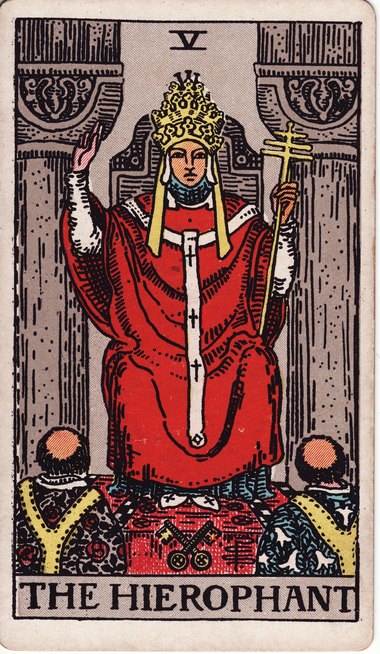
The 1909 Waite-Smith deck, drawn by Pamela Colman Smith in London, from scans of a printing of that era rather than a modern reprint.
Can I use it on my phone?
Yes. It is one responsive site, and on a phone you can answer the card’s question by speaking instead of typing.