Two things no other tarot does.
You get two things here that a tarot app does not usually give you. The reading changes when you say what you noticed in the picture. And the sky it names is the real one, worked out at the minute you read, with the date it moves on. The first is a method no other tarot app uses. The second is arithmetic a language model cannot do reliably.
1. The reading reopens from what you noticed
The reading arrives first, so nothing is held back until you perform for it. Then the card invites you to touch whatever caught your eye, and it is rewritten from that detail. Every one of the seventy-eight forks four ways, which is three hundred and twelve readings, not seventy-eight.
- 78cards
- 24spreads
- 36decans
- The Sun, now☉ 1.8° Libra, Two of Swords
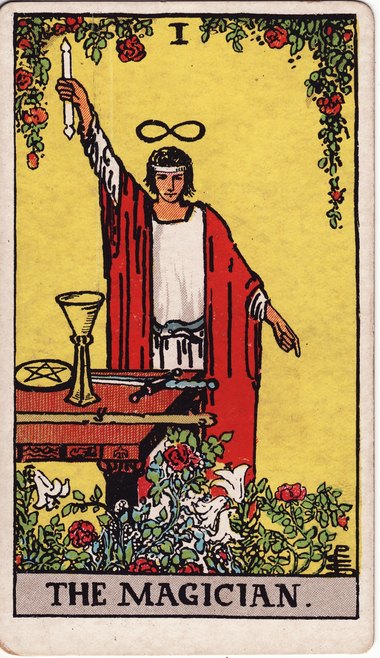
This is how a human reader works and it is the step digital tarot deleted. The card is ambiguous on purpose; the half you supply is the half that makes the reading yours. Two people turning the same card and noticing different things get two different readings, and both are right.
It is also slow to build, which is why nobody else has. The four openings on each card had to be written by hand, card by card, before any of them could be offered. An app that generates the reading on the spot has nothing to fork.
2. It prints one sentence you could check
Every numbered card in the deck was assigned ten degrees of the zodiac by the Golden Dawn in 1888. This site runs an ephemeris while you read, so when the Sun, the Moon or a planet is inside your card’s ten degrees at that minute, the reading says so and gives the date it moves on. When nothing is there, it says nothing.
That sentence would be false if it were wrong, which makes it the only checkable claim in any tarot product. It is why the card lights gold on the cloth when the sky is on it, and why the reading separates what is a fact from what is a reading, in two different typefaces.
It needs a real ephemeris, current degrees, retrogrades and ingress dates, wired to thirty-six cards and kept right for ever. A chatbot asked where the Moon is tonight answers confidently and often wrongly. This site computes it.
3. It comes back and asks how it went
Keep a reading and it saves the cards, your answers and the sky they were drawn under. A few days later it asks how it actually went, in one tap, and that answer becomes part of the record. The next reading can refer to the last one.
Over a year that is a journal that writes itself and a record of your own hit rate, kept for you and never turned into a marketing claim.
4. The draw is sealed before you touch it
The order of the deck is fixed and fingerprinted before you touch it, and the seed is shown after the turn so anyone can recompute the draw. The card you take is the position you chose in an order settled before your hand moved. Nobody, including the engine, sees your card before you do.
Reversals are decided in the same shuffle as the order, not at the moment a card is turned. A card sitting upside down in the deck was already that way up when you reached for it, which is truer to the physical object than a coin flip at the turn.
| Instead of | What they do well | Why people pick this |
|---|---|---|
| A general chatbot | Free, warm, instant, endless follow-ups | It never makes you look first, and it cannot reliably say where the Moon is tonight. Its tarot is language about language. |
| Other AI tarot apps | Polish, card backs, push notifications | Generic prose with no Socratic step and no computation behind it. The edge is distribution, not method. |
| Meaning encyclopedias | Deep reference on all 78 cards | They are reference, not a reading. This asks you a question and answers it. |
| Live psychic lines | A human on the other end | They cost by the minute. This is free, private, and available at seven in the morning. |