Nine of Swords.
Three in the morning made visible.
Upright, then reversed, as Waite gave them in 1910.
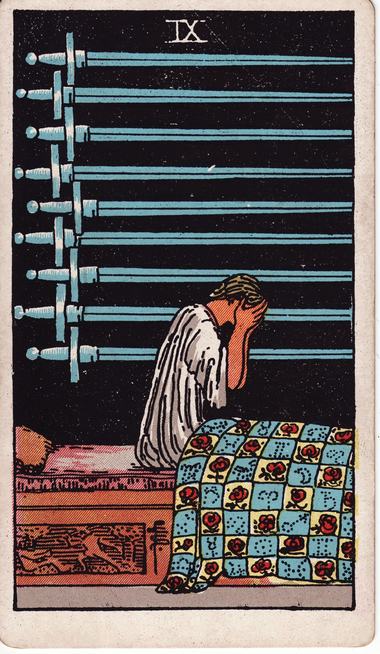
Nine swords in a row on the wall, and none of them touching her. She sits up in bed with both hands over her face, and the quilt over her legs, roses and the signs of the zodiac, is the only colour in the room.
Anguish manufactured indoors, by a mind, at night. The swords are real and they were there before tonight. The picture stays dark for exactly as long as she keeps her hands where they are. Whatever woke you is not in the room, and you have already checked.
Four things people go to on this card
- her hands
You went to the hands first. They are the only part of the figure doing anything, and what they are doing is not looking.
The card is not about what happened. It is about the position being held. Nothing in the picture changes while the hands stay where they are, and the hands are the only thing in it she controls.
That is a description of three in the morning rather than a criticism of her. The smallest available move is to take them down and see the room, which is dark and has a bed in it and nothing else. You have not looked yet. The room is smaller than what you are picturing behind your hands.
What would you actually see if you took your hands down and looked at the room?
- the swords
You went to the swords: nine of them, on the wall, none touching her, and they have been there a while.
They were there before tonight. These are the things you already know and have already survived, arranged in a row, and the row is presented at night as evidence.
The row is not new information. Every sword on that wall has a date on it, and none of the dates is today. Which of them you have already survived is a thing you know, and the difference between knowing it and saying it out loud is most of what the night is for.
Which of these have you already survived, and when did you last say so out loud?
- the quilt
The quilt: roses and the signs of the zodiac, in colour, the only colour in the room.
Somebody made that. Somebody cared enough about her to put roses on a bed, and the stitching took longer than the night will.
The care is in the picture and she is lying under it and cannot see it. That is worth sitting with, because it is almost always true and almost never felt at the time. Somebody put roses on your bed, and whether you have ever told them you noticed is a separate question from whether you noticed.
Who put roses on your bed, and have you ever told them you noticed?
- the carving
The carving on the side of the bed shows one figure defeating another, in a room where nobody else is present.
The only fight in the picture is a picture. A real contest, fought in effigy, at night, by one person, on the furniture.
That is precise about what this card is. Nothing gets decided here. It gets rehearsed, and rehearsal at this hour is always for a fight the other party does not know is scheduled. You are rehearsing an argument with somebody, and they are asleep.
Who are you rehearsing an argument with, and what would happen if you had it for real?
Its ten degrees
The Golden Dawn gave the Nine of Swords 10° to 20° of Gemini, ruled by Mars, and Book T calls it the Lord of Despair and Cruelty. The Sun is in it from 31 May to 11 June. The decan page for this card.
The wheel runs on from here. The decan before this one is Eight of Swords, Jupiter in Gemini, 21 May to 31 May. The one after is Ten of Swords, the Sun in Gemini, 11 June to 21 June. All thirty-six, in order.
On the Tree of Life, Book T puts the Nine of Swords on Yesod, the foundation, in Yetzirah, the world of air: every nine is Yesod, in its own suit's world. It is the ninth place in the Tree of Life spread.
Draw a card, and if this one turns, press whichever of these four you went to and the reading is written from there instead. Pulled it in a spread of your own? Read the whole spread here.
← Eight of Swords · Nine of Wands · Nine of Cups · Nine of Pentacles · Ten of Swords →