The Hierophant.
The rule taught, the keys on the floor.
Upright, then reversed, as Waite gave them in 1910.
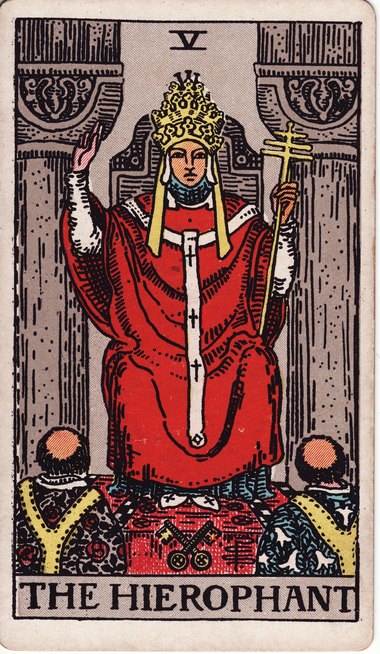
A figure in red on a stone throne between two grey pillars, triple cross in one hand, the other raised in a fixed sign. Two monks kneel below, one robe worked with roses and one with lilies. Crossed keys lie on the step.
The rule is older than the man giving it. The keys are on the floor rather than in anybody's hand, and that is what makes the card honest. Somebody is teaching you the rule, and nobody in the picture is holding the thing that would unlock it.
Four things people go to on this card
- the two kneeling
You went to the two kneeling below him. One robe is covered in roses, the other in lilies.
The transmission rather than the man. Somebody is receiving, which is what makes this a teaching and not a speech. Take the two of them out and he is a man in a chair making a sign at nobody.
They wear the roses and the lilies from the Magician's garden, which puts appetite and clarity at the feet of an institution to be told what to do with themselves. Somewhere in this you are repeating a version of something you were handed. It is worth finding out who handed it over, and whether they were right.
Who taught you the version of this you are repeating, and have you checked it?
- the keys
The keys stopped you. Crossed, on the step below him, and nobody in the picture is holding them.
Access that belongs to the office and not the person. They are lying on the floor of the institution and he is sitting above them, and they would still be there if he were not.
That is the unsentimental reading of any authority: the thing that opens doors is attached to the chair. Ask what in your situation would still be true if the person currently in the role walked out this afternoon. Whatever survives that is the actual structure. The rest is a personality you have been negotiating with.
What here belongs to the role rather than the person in it?
- his raised hand
You chose the hand. Two fingers up, two folded: a sign rather than a gesture.
A thing said the same way every time. The sign is fixed. It means what it meant a hundred years ago, and that is exactly its value and exactly its limit.
This is the only card in the deck whose whole content is repetition, and the picture is not embarrassed about it. Some things in your life should be said identically every time, because the sameness is the message. Others have gone stiff. You know which of yours you last said freshly, because you can remember doing it.
What in your life needs to be said the same way every time, and what needs saying freshly?
- the pillars
You went to the pillars. Plain grey stone, both the same, one on either side of him.
These are deliberately not the High Priestess's. Hers are one black and one white and she sits in the gap between them. His are identical and he sits in front of them, with his back to the wall they hold up.
There is nothing to be between here and no threshold to cross. It is a building, and a building is either the security of this card or the whole problem with it, depending on what you came for. Answer that before you take the advice you are about to be given.
Did you come here for an answer or for the safety of the building?
On the Tree of Life, The Hierophant is the sixteenth path, Vau, from Chokmah to Chesed, in the Golden Dawn's attribution (Liber 777).
Draw a card, and if this one turns, press whichever of these four you went to and the reading is written from there instead. Pulled it in a spread of your own? Read the whole spread here.