Death.
Ground cleared, and one white rose.
Upright, then reversed, as Waite gave them in 1910.
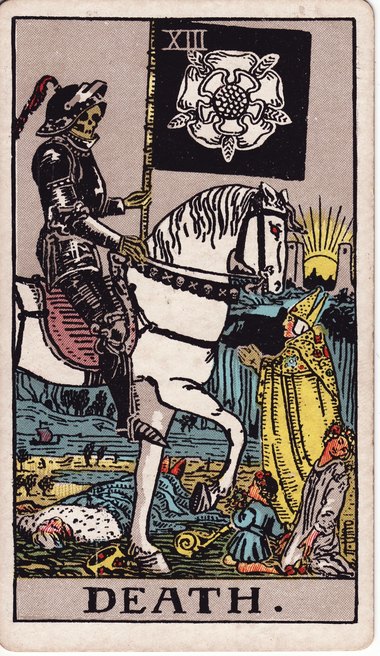
A skeleton in black armour rides a white horse at a walk, carrying a black banner with one white rose on it. A king lies dead under the hooves. A bishop faces the horse with his hands up, a woman turns away, a child kneels with flowers.
An ending, and the ground it clears. Watch who is looking: one meets it, one turns away, and the youngest is nearest the horse. One part of you is meeting this. One part has turned its head. The youngest part of you is standing closest to it.
Four things people go to on this card
- the white rose
You went to the banner. Black, with a single white rose on it, five petals.
The one clean thing in the picture is on the flag of the thing everyone is afraid of. Five white petals on black, carried at the front, where a coat of arms would go.
The card is not saying an ending is good. It is saying an ending is the only thing that clears ground, and that a rose is what grows in cleared ground and will not grow in any other kind. Something in your life has no room because of what is still standing in it. Name what would have room.
What would have room to grow if this actually ended?
- the bishop
The figure in gold took you. Standing, facing it, hands up, the only adult still upright.
The difference between the people who look at it and the people who do not. The king is already down. The woman has turned her head. The child is holding flowers up at it. He is meeting it, and he is not stopping it.
That is the only position actually available, and the card gives it to the person whose entire profession is explaining death, which is either a compliment or a joke. Somebody in your situation is looking straight at this thing. Work out who, and then work out whether it is you or whether you have been relying on them.
Who in this is looking at it directly, and are you one of them?
- the child
You went to the child, kneeling at the front, holding up a posy, not afraid.
Not everybody in a change is losing something. The king is finished and the child has brought flowers and is nearer the horse than anyone. Nothing in the drawing suggests the child has misunderstood.
Which is uncomfortable and true. In every ending there is somebody meeting it simply as the state of the world, and it is often the youngest person present, because they have nothing invested in the version that is going. Find that person in yours. They can see something you cannot, and it is not optimism.
Who in this is not losing anything, and what do they see that you do not?
- the far edge
You went past all of them to the far edge. Two towers, and the sun coming up between them.
A sunrise has been put behind a funeral and nobody has commented on it. It is small, at the very edge of the plate, and not one figure in the scene is facing that way.
This is the thirteenth card and it is a threshold rather than a conclusion. Something is on the other side of this, and the picture has drawn it small and far off, which is the honest scale from where you are standing. Do not let anybody enlarge it for you yet.
What is on the other side of this that you cannot see properly from here?
On the Tree of Life, Death is the twenty-fourth path, Nun, from Tiphareth to Netzach, in the Golden Dawn's attribution (Liber 777).
Draw a card, and if this one turns, press whichever of these four you went to and the reading is written from there instead. Pulled it in a spread of your own? Read the whole spread here.