Justice.
The pans still moving, the sword already up.
Upright, then reversed, as Waite gave them in 1910.
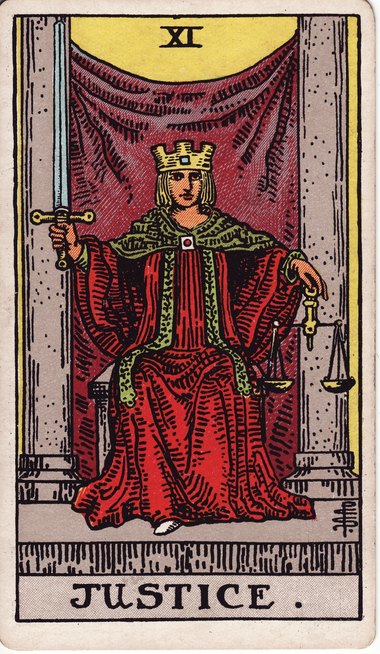
A crowned figure sits between two pillars with a veil hung behind. An upright sword in the right hand, a pair of scales in the left, and the pans are not level. One white shoe shows under the hem.
Weighing, and then consequence. The scales have not settled and the sword is already up, which is the honest order of events in most decisions rather than the tidy one. You can feel both at once in this: something is still being worked out, and something has already been decided.
Four things people go to on this card
- the sword
You went to the sword. Upright, in the right hand, and the only weapon in the card.
A decision that will actually be enforced. It is not the scales that make this justice rather than an opinion, it is the blade standing next to them, and the blade is held higher than the scales.
Weighing is only justice if something happens afterwards. That is the correction this card makes to every gentle reading of balance. You have weighed this, at length, more than once. The part you have not done is the part with the sword in it, and no amount of further weighing will produce it.
You have weighed this. What actually happens afterwards?
- the scales
You picked the scales. They hang from her left hand, and the pans are not level.
A judgement in progress rather than a verdict. The pans are still settling. Nothing in this picture has been concluded, which is easy to miss because everything about the pose says it has.
That is the most useful thing in the card for anybody in the middle of deciding something. It is a portrait of the middle, and the middle is allowed to take as long as it takes. What you are rushing has not finished moving. Rushing it will produce a verdict, and the verdict will be wrong.
What are you rushing to conclude that has not finished settling?
- her shoe
Your eye found the foot. A white shoe just showing under the hem, and you would not see it unless you looked.
There is a person in this card. The robes and the pillars and the sword are the office; the shoe belongs to somebody who put it on this morning and will take it off tonight.
Which matters most when you are on the receiving end of a decision. It was made by a person, that person is as answerable as the office they made it in, and they knew your name while they did it. Work out who actually decided this. Not which department. Who.
Who actually made this decision, as opposed to which office made it?
- the veil
The curtain behind her stopped you, hung between the pillars, hiding whatever is back there.
This card is shaped like the High Priestess and reaches the opposite conclusion. Both figures sit between pillars with something concealed behind them. One of them is holding a scroll. This one is holding a sword.
So the difference between the two is what gets done with what is known. One keeps it and waits to be asked. The other acts on it and accepts the consequences of having acted. Your situation needs one of those two, and you have been doing the other one because it is the one you are good at.
Does this need somebody to hold what they know, or to act on it?
On the Tree of Life, Justice is the twenty-second path, Lamed, from Geburah to Tiphareth, in the Golden Dawn's attribution (Liber 777).
Draw a card, and if this one turns, press whichever of these four you went to and the reading is written from there instead. Pulled it in a spread of your own? Read the whole spread here.