Ace of Wands.
A cut branch, sprouting anyway.
Upright, then reversed, as Waite gave them in 1910.
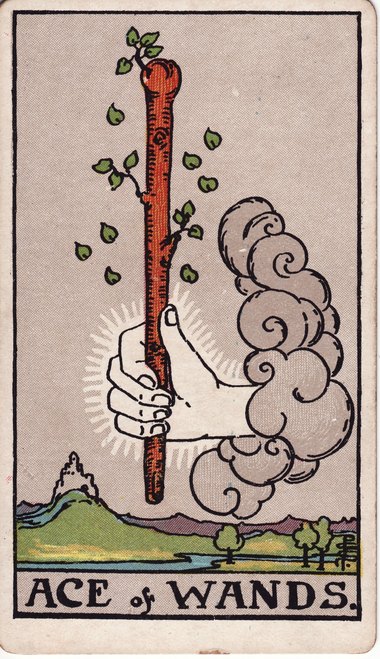
A stick in a hand out of a cloud. The stick is alive. Bark on it, a stump where a limb came off, leaves coming out of the wood and eight more already falling. Below, a river and a castle the size of a thumbnail.
The hand is not yours. The branch was cut and is sprouting anyway, shedding as it goes, which is what a beginning costs when it is real. Something in you has started without asking permission, and eight leaves have already gone.
Four things people go to on this card
- the leaves
You went to the loose leaves, eight of them already off the rod and falling while the rod is still sprouting.
The branch is alive, which is why it is shedding. Nothing in the picture is dying and something is being dropped on every side of it. That is the cost of growth rather than the thrill of it, and the card puts the cost in the air where it is easy to miss.
If you are starting something at the moment, the honest question is not what it will give you. It is what it is already quietly costing, which you have not counted because the thing is going well.
What is this new thing already costing you that you have not counted, because it is going well?
- the hand
It was the hand you touched, coming out of a cloud, and the aces never say whose it is.
Nobody here made this. A chance, a mood, a good week, someone else's decision: the hand came out of a cloud and put the branch where you could take it. The picture is exact that the start was not manufactured.
That is not a small thing to admit. Most people would rather have earned it, and spend the first month of anything new inventing a reason they deserved it. The card does not require that of you.
If nothing here needs deserving, what would you actually start today?
- the castle
You went past the wand to the far bank, where a small castle sits on a hill with the river between.
Something is offered in the foreground and there is somewhere it could go. The two are separated by water and most of the frame. That turns the ace from a feeling into a direction, and the gap is the honest part of it.
Wands are doing rather than having. You have the impulse, and the impulse is not small. What you do not yet have is the crossing, and the card has drawn the water so you cannot pretend otherwise.
You have the impulse. What is the first crossing, and when this week does it happen?
- the branch
Your eye went to the wand itself, a cut branch and not a made thing, bark still on it and leaves coming out of the wood.
The tool has not been planed, turned or polished. It is a stick that is still alive, and that is the whole of its power. Starting with what is to hand, rather than with what is finished, is the specific offer here.
If you are waiting to be ready, the card is unsympathetic. Readiness is what the other suits are for. This one is about picking up the rough thing and going, and the leaves on it say it will survive being picked up rough.
What are you waiting to be ready for that you could start rough this week?
On the Tree of Life, Book T puts the Ace of Wands on Kether, the crown, in Atziluth, the world of fire: the root of the suit. It is the first place in the Tree of Life spread.
Draw a card, and if this one turns, press whichever of these four you went to and the reading is written from there instead. Pulled it in a spread of your own? Read the whole spread here.
← The World · Ace of Cups · Ace of Swords · Ace of Pentacles · Two of Wands →