Ace of Swords.
Clarity, offered edge first.
Upright, then reversed, as Waite gave them in 1910.
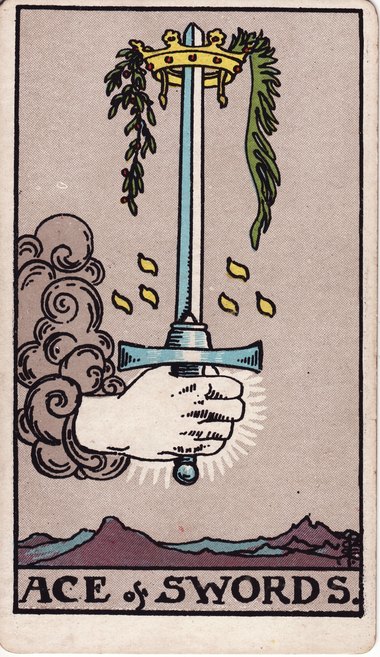
A hand comes out of a cloud holding a sword straight up. On the point sits a crown, with an olive branch hung from one side of it and a palm from the other. Below, bare peaks and no path.
Clarity, or a decision, or the truth arriving whether it was wanted. Peace and victory both hang off the blade, and the blade is the only part on offer. The hand has the hilt. What faces you is the edge, and whatever became plain this week arrived the same way.
Four things people go to on this card
- the crown
You went to the crown. It sits on the sword's point and nobody is wearing it.
Authority that comes from being right rather than from rank. Nobody handed this crown down. It rests on the thing that earned it, which is also the thing that could tip it off.
That is the whole cost of the ace. Seeing plainly gives you a kind of power and takes away every excuse in the same motion. Once you can see it, you are answerable for it, and the crown is balanced on exactly that.
What have you seen clearly enough that you can no longer claim not to know it?
- the two branches
The branches caught you: olive on one side, palm on the other, hung from a crown on a bare blade.
Olive is peace and palm is victory, and the picture stakes both on a sword. Air cuts. The calm it produces is the calm after something has been settled, not instead of it.
If you are heading for a hard conversation, this is not a card warning you off. The quiet you want is on the far side of the conversation, and there is no drawn route around it.
What conversation is the only route to the quiet you actually want?
- the hand
You went to the hand. It comes out of a cloud, and the card never says whose it is.
The clarity arrived. You did not reason your way to it in the shower or earn it over a long weekend. It landed, the way things land, and the card is honest that the timing was never yours.
What is yours is what happens next. An offered blade is only a blade until somebody takes it and decides what it is for, and the hand in the cloud is not going to do that part.
Something became obvious recently without you working for it. What are you going to do with it?
- the mountains
Your eye dropped to the ground: bare jagged peaks, no path, no people, along the bottom of the frame.
This is the country a clear decision has to be carried across. The sword is at the top of the picture and the ground is at the bottom, and there is most of the card between them.
Knowing the right thing and doing it are separated here by the hardest terrain in the deck. That gap is normal. Naming it is better than pretending the decision was the work, which is the mistake you are closest to making.
You know the right call. What is the first hard step of actually making it?
On the Tree of Life, Book T puts the Ace of Swords on Kether, the crown, in Yetzirah, the world of air: the root of the suit. It is the first place in the Tree of Life spread.
Draw a card, and if this one turns, press whichever of these four you went to and the reading is written from there instead. Pulled it in a spread of your own? Read the whole spread here.
← King of Cups · Ace of Wands · Ace of Cups · Ace of Pentacles · Two of Swords →