Five of Swords.
A win that emptied the field.
Upright, then reversed, as Waite gave them in 1910.
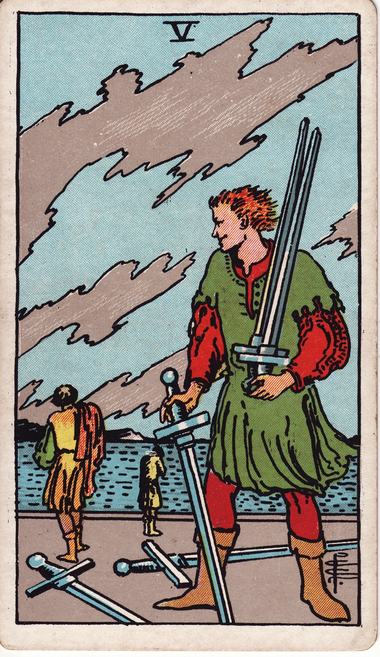
He has three of the swords and a look on his face. Two figures walk away towards the water with their heads down. Two swords lie on the sand. The sky is torn.
Winning badly looks like this. A hollow victory: the field is his and the field is empty. The card is unusual in the deck for having a clear villain and refusing to say whether you are him.
Four things people go to on this card
- his face
You went to his expression. It is the nastiest face in the deck, and the deck has the Devil in it.
The moment after winning, when the winning turns out to be the smaller part. He has the swords and he is enjoying it, and the enjoyment is the thing the card puts nearest to you.
If you recognise the face, that is the reading. Nobody feels like the villain from the inside. They feel like the person who was finally proved right, and being proved right is exactly what you have been describing as the good news.
Where were you proved right recently, and what did it cost the room?
- the two leaving
You followed the two leaving. Heads down, backs turned, not arguing, already gone.
The argument is over, and the relationship is what is walking off. They are not conceding a point. They have stopped playing, which is a different and much more expensive outcome.
This is what people mean by winning and losing at the same time. The card puts the loss in the middle distance, where it is easy not to look at, and where you have been keeping it.
Who has stopped arguing with you, and did you notice it as agreement?
- the swords on the ground
You went to the ones nobody picked up. Two swords on the sand, at the front of the picture, abandoned.
Not everything got taken. Two arguments were dropped rather than won, and they are lying in the open where anyone could pick them up again.
Unfinished fights do not decay. They sit at the front of the frame and wait, and this is the only card in the deck that draws them so plainly. Whoever walks back down this beach first, you or them, will find them exactly where they fell.
Which dropped argument is still lying there, and who is more likely to pick it up first?
- the sky
The sky is what you noticed: ragged grey shapes on blue, like cloth pulled apart.
The weather over this scene is damaged rather than dark. Not a storm. Something torn, which does not mend on its own the way weather does.
That is the residue of a certain kind of fight. Nothing dramatic remains, and the atmosphere is simply wrong afterwards, for a while, in a way nobody quite mentions. If the room has felt like that since, it is not you imagining it, and it is not going to lift by itself.
What has felt slightly wrong since, that nobody has named out loud?
Its ten degrees
The Golden Dawn gave the Five of Swords 0° to 10° of Aquarius, ruled by Venus, and Book T calls it the Lord of Defeat. The Sun is in it from 20 January to 30 January. The decan page for this card.
The wheel runs on from here. The decan before this one is Four of Pentacles, the Sun in Capricorn, 10 January to 20 January. The one after is Six of Swords, Mercury in Aquarius, 30 January to 9 February. All thirty-six, in order.
On the Tree of Life, Book T puts the Five of Swords on Geburah, severity, in Yetzirah, the world of air: every five is Geburah, in its own suit's world. It is the fifth place in the Tree of Life spread.
Draw a card, and if this one turns, press whichever of these four you went to and the reading is written from there instead. Pulled it in a spread of your own? Read the whole spread here.
← Four of Swords · Five of Wands · Five of Cups · Five of Pentacles · Six of Swords →