Six of Swords.
Somewhere better, with the swords aboard.
Upright, then reversed, as Waite gave them in 1910.
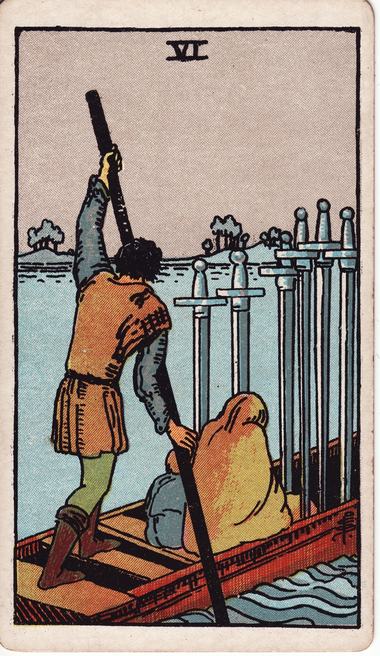
A ferryman poles a shallow boat across the water. A hooded passenger and a child sit in front of him, neither looking up. Six swords stand upright in the hull. Behind the boat the water is choppy; ahead of it, smooth.
A crossing rather than an arrival. Passage away from difficulty, and the swords came too. You are going somewhere better and you have brought the thing with you, and the boat is still floating, which is the whole of the good news.
Four things people go to on this card
- the six swords
You went to the swords. Six of them, upright, driven through the floor of the boat they are travelling in.
The trouble is aboard. It is not being left on the bank behind them. It is standing in the hull, point down, coming along, and nobody has thrown it over the side.
That is the honest version of moving on. You do not get to leave it behind. You get to carry it somewhere it does less damage, and the card thinks that is worth the trip, even with the extra weight in the bow.
What are you taking with you that you had been telling yourself you were leaving behind?
- the ferryman
You picked the man with the pole. He is standing, working, and the card does not show his face either.
Somebody is doing the moving and it is not the passengers. He is not going anywhere himself. He crosses and comes back, and crosses again. This is his job.
Somebody in your situation is doing the ferrying, and it may be you. If it is, the card notes that nobody in the boat has looked at you once, and that you have not stopped poling to mention it.
Who is doing the ferrying here, and has anyone thanked them?
- the passengers
You went to the passengers. One covered head to foot, one small, sitting close, neither looking up.
This crossing is being made with somebody who did not choose it. The child is going because the adult is going. That is most departures, honestly described.
The card does not moralise about it. It draws the second person, who is smaller, and who has been given no vote. Whoever is sitting beside you in this, they have had less say than you and have made less noise about it.
Who is coming with you on this, and when did you last ask them how they are finding it?
- the water
You stopped at the water: choppy behind the boat, smooth ahead of it, and the card is not subtle about which is which.
The improvement is real and it is gradual. Not a shore, not an arrival. Just water that has stopped fighting the hull, which is what getting better feels like from inside it.
People wait for a bank. The card offers calmer water instead, which is what is on the table for you this month, and it is more than it sounds. Look over the side, not ahead.
What has quietly got easier lately that you have not given yourself credit for?
Its ten degrees
The Golden Dawn gave the Six of Swords 10° to 20° of Aquarius, ruled by Mercury, and Book T calls it the Lord of Earned Success. The Sun is in it from 30 January to 9 February. The decan page for this card.
The wheel runs on from here. The decan before this one is Five of Swords, Venus in Aquarius, 20 January to 30 January. The one after is Seven of Swords, the Moon in Aquarius, 9 February to 18 February. All thirty-six, in order.
On the Tree of Life, Book T puts the Six of Swords on Tiphareth, beauty, in Yetzirah, the world of air: every six is Tiphareth, in its own suit's world. It is the sixth place in the Tree of Life spread.
Draw a card, and if this one turns, press whichever of these four you went to and the reading is written from there instead. Pulled it in a spread of your own? Read the whole spread here.
← Five of Swords · Six of Wands · Six of Cups · Six of Pentacles · Seven of Swords →