Six of Wands.
Recognition, and already looking past it.
Upright, then reversed, as Waite gave them in 1910.
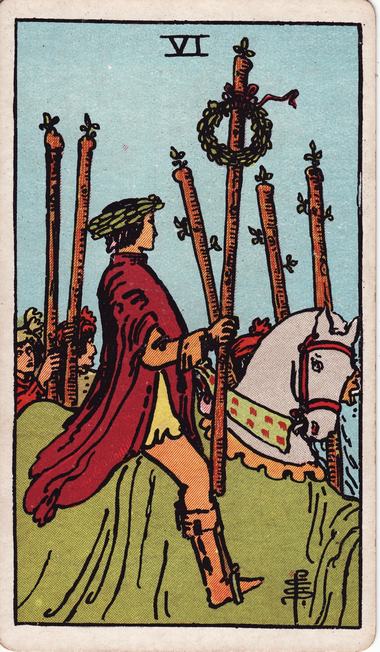
A rider with laurel on his head and a second wreath tied to his staff. His horse is white and dressed for the day. The people on foot walk alongside, staves up, faces half out of the frame, and he is not looking at them.
This is a return, not a battle. Recognition, and the card arranges it exactly: one man mounted, everyone else walking, his eyes already past the crowd. The moment does not repeat, and if it is yours, you are the one person in the procession most likely to miss it.
Four things people go to on this card
- the wreath
You went to the wreath, and there are two, one tied to his staff and one on his head, the same laurel in both.
Laurel is old and specific. It is what a return gets, not what a victory feels like from inside, and it is worn where other people can see it. A win has been made visible, which is a separate event from the win.
The thing itself may be modest. The card is about how large it has been allowed to become in the telling, and two wreaths for one ride is already a hint. Ask whether the version you have been telling people is the size of the thing.
Is the thing itself as large as the version of it you have been telling people?
- the horse
It was the horse you touched, white, decorated, walking, doing the moving while he holds the staff.
Something carried you. The rider is not looking at it. Someone lent something, something went right that you did not arrange, and the horse is dressed for the occasion too, in a cloth somebody else sewed.
That is not a criticism. It is an accurate description of most wins, and the picture is generous about it: the horse is the largest thing on the card. The question is only whether you have named the horse to anybody.
What carried you here that you have not named to anyone?
- the walkers
You went to the people on foot, their staves up, their faces half out of the frame, walking while he rides.
Five staves belong to people we cannot see properly. He is the only one drawn in full, which is the gap between being at the front and being in the group, put on the card as a matter of cropping.
If you are the rider at the moment, the card is asking whether the others know they were in it. If you are one of the walkers, it is asking a harder question about whether you mind, and it does not think you should have to answer quickly.
Are you the rider or one of the walkers here, and how do you actually feel about it?
- his eyes
Your eye went to his, in profile, looking forward and slightly down, and not at the crowd.
A public success has a strange privacy. He is in the middle of a procession and his attention is entirely somewhere else, probably on the next thing, and the laurel is not the thing he is thinking about.
That is worth catching in yourself. The people walking beside you are having the day; you are already three moves past it. Whether that is a gift or a loss depends on what the next thing is, and the card does not know.
Are you actually in this moment, or already three moves past it?
Its ten degrees
The Golden Dawn gave the Six of Wands 10° to 20° of Leo, ruled by Jupiter, and Book T calls it the Lord of Victory. The Sun is in it from 2 August to 12 August. Power draw Jupiter is on this card tonight. The decan page for this card.
The wheel runs on from here. The decan before this one is Five of Wands, Saturn in Leo, 23 July to 2 August. The one after is Seven of Wands, Mars in Leo, 12 August to 23 August. All thirty-six, in order.
On the Tree of Life, Book T puts the Six of Wands on Tiphareth, beauty, in Atziluth, the world of fire: every six is Tiphareth, in its own suit's world. It is the sixth place in the Tree of Life spread.
Draw a card, and if this one turns, press whichever of these four you went to and the reading is written from there instead. Pulled it in a spread of your own? Read the whole spread here.
← Five of Wands · Six of Cups · Six of Swords · Six of Pentacles · Seven of Wands →