Six of Cups.
Kindness that cost somebody a season.
Upright, then reversed, as Waite gave them in 1910.
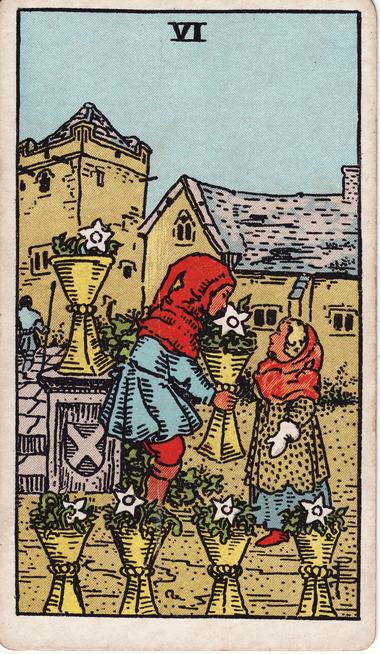
Inside a walled courtyard, a hooded figure hands a child a cup of white flowers. Six cups, flowers in every one. Behind them a tower, roofs, and a small figure with a pike leaving by the gate.
This is the card of the past, and the past in it is sweet. The flowers were grown, not picked wild, and they sit in a cup instead of a drink. The wall is stone and the gate is open. Somebody was kind to you inside a wall like that, and it cost more than you saw.
Four things people go to on this card
- the offered cup
You went to the handing over. One figure gives the other a cup, and there is nothing to drink in it.
Look at what the giving costs in posture alone. The taller figure is bent almost double and the small one does not have to move at all. That is the shape of kindness done to somebody who cannot return it.
The flowers in the cup took a season of somebody's ordinary weeks, and it probably went unremarked at the time. You are old enough now to see the arithmetic of it, which is late. Late is not the same as useless, and the people who did that for you are mostly still reachable.
Who spent a season on you, and is there a message you could still send them?
- the flowers
You went to what is in them. Six cups, flowers in all of them, nothing anybody could drink.
Sweet, decorative, deeply familiar, and not food. Nostalgia works exactly like this. It gives you the shape of nourishment with the nourishment left out, and the reason it is so hard to stop is that it is genuinely lovely.
The card is not against the flowers. It has drawn six cupfuls of them with care. It is only noticing that you have spent an evening on something that will not hold you until morning, and that you already know what would.
That was lovely and it was not food. What have you actually eaten today?
- the far figure
The small figure at the edge is what caught you. Somebody with a pike is walking out of the courtyard and the card does not explain them.
Every warm reading of this picture depends on nobody looking at the guard. He is the size of a thumbnail, he is armed, and he is going away, and the moment you notice him the garden acquires an outside and the wall acquires a reason.
You looked. That generally means the memory you are holding has an absence in it: somebody who left, or was sent away, or died before you had the words for it. The absence is usually the part that has never been said out loud in the family.
Who is missing from the memory, and what have you never said about their leaving?
- the X on the plinth
The mark is where you stopped. It is cut into the stone plinth at the front of the courtyard and nobody has ever settled what it means.
A saltire on a block of stone, at the threshold of a garden, in a picture otherwise made entirely of sweetness. It has been argued over for a century and no answer has stuck.
Your own past has one of these. A year, a house, a person who is marked in you and has never been explained, and you know exactly where it is even though you could not say what it stands for. Knowing the location is not nothing. It is most of what is needed to go and look.
You know where the mark is. What would it take to go and look?
Its ten degrees
The Golden Dawn gave the Six of Cups 10° to 20° of Scorpio, ruled by the Sun, and Book T calls it the Lord of Pleasure. The Sun is in it from 2 November to 12 November. The decan page for this card.
The wheel runs on from here. The decan before this one is Five of Cups, Mars in Scorpio, 23 October to 2 November. The one after is Seven of Cups, Venus in Scorpio, 12 November to 22 November. All thirty-six, in order.
On the Tree of Life, Book T puts the Six of Cups on Tiphareth, beauty, in Briah, the world of water: every six is Tiphareth, in its own suit's world. It is the sixth place in the Tree of Life spread.
Draw a card, and if this one turns, press whichever of these four you went to and the reading is written from there instead. Pulled it in a spread of your own? Read the whole spread here.
← Five of Cups · Six of Wands · Six of Swords · Six of Pentacles · Seven of Cups →