Seven of Wands.
Higher than all of them, in the wrong shoes.
Upright, then reversed, as Waite gave them in 1910.
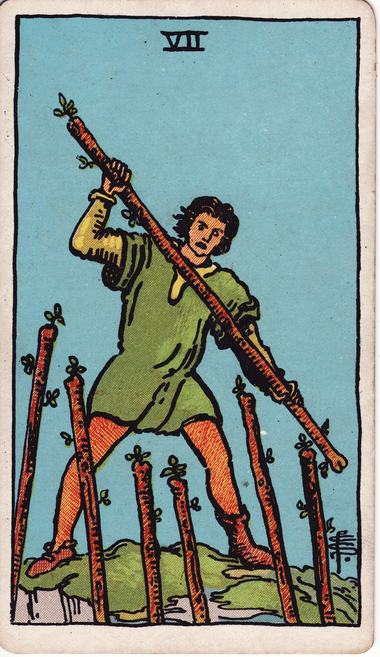
One man on a ledge, six staves coming up at him from below the edge of the card. No hands on any of them. Both of his are on his own staff, mid-swing, and he is wearing one boot and one shoe.
He is higher than all of them. Six against one reads as terrible odds until you notice that none of the six can reach him, and that he was doing something else when this started. You are winning this and you got dressed in a hurry, and both are true.
Four things people go to on this card
- the high ground
You went to the ledge, where he stands above them and the six staves come up from below the edge.
He is higher. That is the advantage you already have and keep leaving out of the count, because six against one sounds like the whole story and the ledge sounds like scenery. It is not scenery. It is the reason he is still standing.
Valour is the old name for this card, and valour is not the same as being outmatched. It is holding a position you are entitled to hold. If you are counting the odds against you, count the ledge first; it changes the sum.
What advantage do you already have in this that you keep leaving out of the count?
- the six staves
It was the six staves you touched, coming up from the bottom edge, and not one with a hand on it that you can see.
Six things are coming at him and the picture refuses to say who is holding them. That is not an accident of drawing. Opposition you have not identified is a different thing from opposition, and it is drawn here as sticks with nobody attached.
Half of what feels like pressure has no person behind it. Before you defend anything further, name who is actually pushing, one staff at a time, and see how many of the six turn out to be nobody.
Name who is actually pushing on you here. How many of the six turn out to be nobody?
- his boots
You went to his feet: one boot and one shoe, and it was drawn that way on purpose.
He did not dress for this. He was doing something else and had to turn round and hold, and the feet say so more plainly than the face does. Caught mid-something is the whole condition of the card.
That is worth being fair to yourself about. You are not underprepared as a character flaw. You were interrupted, and you are still standing on the high ground in the wrong shoes, which is not a bad record for an interruption.
What were you in the middle of when this started, and can you get back to it?
- his stance
Your eye went to how he is standing, both hands on the staff, swinging downwards, leaning into it.
Effort rather than outcome. He is committed, in the middle of the movement, using both hands, and the card does not tell you whether he wins. It shows the swing and stops there.
There is nothing held back here, which is the risk. Ask whether this is the thing worth both hands, because while they are on this staff they are not on anything else. The six below are not the only things in your life that need a hand.
Is this the thing worth both hands? What are they off while they are on this?
Its ten degrees
The Golden Dawn gave the Seven of Wands 20° to 30° of Leo, ruled by Mars, and Book T calls it the Lord of Valour. The Sun is in it from 12 August to 23 August. The decan page for this card.
The wheel runs on from here. The decan before this one is Six of Wands, Jupiter in Leo, 2 August to 12 August. The one after is Eight of Pentacles, the Sun in Virgo, 23 August to 2 September. All thirty-six, in order.
On the Tree of Life, Book T puts the Seven of Wands on Netzach, victory, in Atziluth, the world of fire: every seven is Netzach, in its own suit's world. It is the seventh place in the Tree of Life spread.
Draw a card, and if this one turns, press whichever of these four you went to and the reading is written from there instead. Pulled it in a spread of your own? Read the whole spread here.
← Six of Wands · Seven of Cups · Seven of Swords · Seven of Pentacles · Eight of Wands →