Four of Swords.
Rest, with the trouble hung on the wall.
Upright, then reversed, as Waite gave them in 1910.
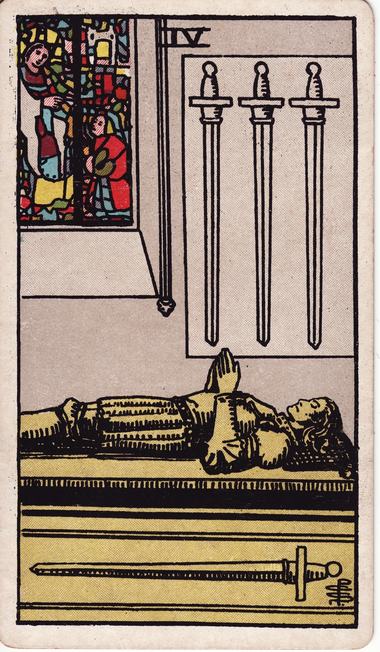
The knight lies in effigy on his own tomb, hands together. Three swords hang on the wall above him, points down. A fourth is carved into the stone he lies on. The window is the only colour in the room.
Recovery, retreat, a stillness with a date on it. The only card in the suit where nothing is happening, and the one people most often need. Nobody lies down like that by accident. You have not given yourself the same permission, and the swords would keep on the wall without you.
Four things people go to on this card
- the three swords
You went to the swords on the wall. Three, hung up, points down, out of reach of a man lying flat.
The discipline of putting things down. They are not gone. They are hung where he cannot pick them up without standing, and standing is the thing he has decided not to do yet.
Rest in this card is not the absence of trouble. It is trouble deliberately hung on a wall for a fixed period, which is the only kind of rest available to anyone with an actual life, and it is the kind you have been telling yourself you cannot take.
What could you hang on the wall until Monday without anything catching fire?
- the fourth sword
You found the fourth sword. It is carved into the side of the tomb, under his body, and it does not hang with the others.
One of them is not on the wall. It is in the stone he is lying on, part of the structure, permanent. Three can be put down. This one is what he is resting on.
There is usually a version of your trouble that will not be set aside because it is load-bearing. It holds the rest of you up, whether you like it or not. Telling that one apart from the other three is most of the work of a proper rest.
Which of your worries is load-bearing, and which three could be hung up tonight?
- the window
You went to the window. The only colour in a grey room, and it shows a figure standing over somebody kneeling.
Light coming into a room where somebody is lying down. Coloured, high up, from outside, and falling on a man who is not looking at it.
Whatever helps you is going on above your head at the moment, while you are horizontal. That is fine. It does not need your attention to keep happening. The card's whole position is that you are allowed to be horizontal, and the window is its evidence that the world manages.
What is going on without you at the moment, and can you leave it that way a bit longer?
- his hands
His hands held you: palms together on his chest, the posture of an effigy rather than a sleeper.
This rest is formal. He is not collapsed. He is arranged, and the arrangement is one people are put in on purpose, which makes this a chosen stillness rather than an exhausted one.
The difference matters. Collapse happens to you. This is scheduled, and scheduled rest is the only kind that repairs anything. If the last time you stopped was because you could not go on, that was not this card, and you are owed one that is.
Is your rest scheduled or is it collapse, and what would it take to make it the first one?
Its ten degrees
The Golden Dawn gave the Four of Swords 20° to 30° of Libra, ruled by Jupiter, and Book T calls it the Lord of Rest from Strife. The Sun is in it from 13 October to 23 October. Power draw Mercury is on this card tonight. The decan page for this card.
The wheel runs on from here. The decan before this one is Three of Swords, Saturn in Libra, 3 October to 13 October. The one after is Five of Cups, Mars in Scorpio, 23 October to 2 November. All thirty-six, in order.
On the Tree of Life, Book T puts the Four of Swords on Chesed, mercy, in Yetzirah, the world of air: every four is Chesed, in its own suit's world. It is the fourth place in the Tree of Life spread.
Draw a card, and if this one turns, press whichever of these four you went to and the reading is written from there instead. Pulled it in a spread of your own? Read the whole spread here.
← Three of Swords · Four of Wands · Four of Cups · Four of Pentacles · Five of Swords →