Three of Swords.
The wound drawn, the scene withheld.
Upright, then reversed, as Waite gave them in 1910.
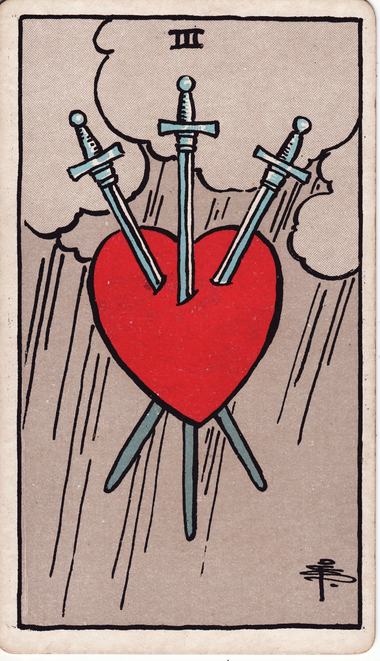
A heart, three swords through it, a grey cloud behind, rain in straight lines across the whole card. No figure, no landscape, no room. It is the plainest picture in the deck.
Sorrow, plainly. What is unusual is the absence of anybody to blame. The card gives you the injury and withholds the scene, and that is a mercy of a kind: nobody in this picture has to be forgiven before you are allowed to hurt.
Four things people go to on this card
- the three swords
You counted the swords. Three, evenly spaced, driven all the way through and left there.
Three is the detail. One would be an accident and two would be bad luck. Three is a pattern, and patterns have a source, which this card refuses to draw.
Sorrow that comes three times from the same direction is information as well as pain. The card will not tell you what to do with that. It only makes the count impossible to miss, and you have been counting it as one.
What has now happened three times, and what have you been calling it instead of a pattern?
- the rain
The rain is where you stopped. It falls across the whole card, behind everything, in straight grey lines.
Weather rather than event. This is the low, continuous, unremarkable part of grief, the part that goes on long after the thing that caused it stopped being news to anyone.
Nobody asks how you are during the rain. It is not dramatic enough to ask about. The card counts it anyway, and draws it right across the frame, which is more attention than it has had from anyone else this month.
How long has it actually been raining, and who still thinks it stopped?
- the cloud
You went to the cloud. Grey, soft-edged, directly behind the heart, and the only other thing in the picture.
The part you cannot see through, and it sits directly behind the injury. The arrangement is exact: the pain is in focus and the situation around it is not.
Grief does this. It makes the wound the one legible thing in a scene where everything else has gone vague. That is not a failure of thinking. It is what the weather does, and the decisions you are finding hard right now are hard for that reason and no other.
What have you stopped being able to see clearly since this happened?
- the heart
You stayed with the heart itself. Not a person, not a face, the symbol alone, drawn plainly in the middle of the card.
No story. No betrayer, no room, no argument, just the organ and the damage at the size of the whole picture.
That is either the cruellest thing in the deck or the kindest, depending on the day. It refuses to turn the hurt into a story you have to be fair about. If you have been building the case, for or against somebody, the card is giving you a morning off from it.
Can you let this be an injury for a while, without needing it to be a story with reasons?
Its ten degrees
The Golden Dawn gave the Three of Swords 10° to 20° of Libra, ruled by Saturn, and Book T calls it the Lord of Sorrow. The Sun is in it from 3 October to 13 October. The decan page for this card.
The wheel runs on from here. The decan before this one is Two of Swords, the Moon in Libra, 23 September to 3 October. The one after is Four of Swords, Jupiter in Libra, 13 October to 23 October. All thirty-six, in order.
On the Tree of Life, Book T puts the Three of Swords on Binah, understanding, in Yetzirah, the world of air: every three is Binah, in its own suit's world. It is the third place in the Tree of Life spread.
Draw a card, and if this one turns, press whichever of these four you went to and the reading is written from there instead. Pulled it in a spread of your own? Read the whole spread here.
← Two of Swords · Three of Wands · Three of Cups · Three of Pentacles · Four of Swords →