Three of Pentacles.
Consulted mid-job, still holding the mallet.
Upright, then reversed, as Waite gave them in 1910.
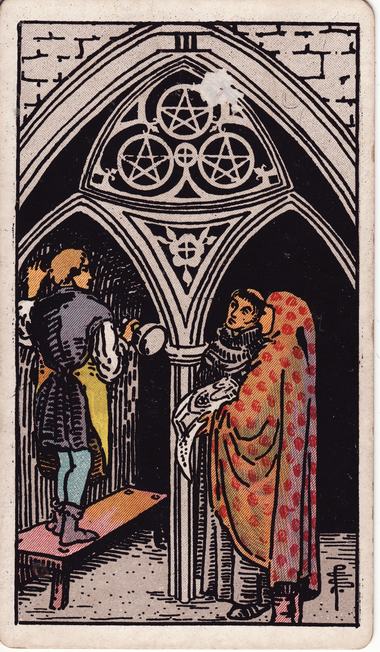
A job in progress. A young mason stands on a bench with his mallet, a monk and a figure in a patterned cloak hold open a drawing between them, and three pentacles are already carved into the arch over all their heads.
Skilled work, and the arrangement is the point. The craftsman is the tallest and the plans are between them. You are in the middle of something with other people, and the useful thing about it is that nobody has downed tools to admire it yet.
Four things people go to on this card
- the bench
You went to the bench. The young man is standing on it, which puts him above both the people he is talking to.
The person actually doing the work is, for the moment, the tallest one in the room. He is a mason; they are a monk and a patron; he is the one holding the mallet and standing on the furniture. Nobody in the picture finds this odd.
Expertise, in the moment of being asked, outranks position. That is the arrangement here and it is a fragile one. Where you are the person who knows how, it is worth checking whether you are speaking from that, or from wherever you sit in the order when the question is not being asked.
Where are you the one who actually knows how, and are you speaking from that or from your rank?
- the plans
You went to the drawing. It is held open between them, and all three are looking at the same sheet.
Nobody here is arguing about each other. They have put a piece of paper between them and the paper is taking the disagreement. That is the whole technology of working together, and it is very easy to skip.
A disagreement with no object in the middle of it becomes a disagreement about the people. If the thing you are currently at odds over exists nowhere outside the conversation, that is the fault, and it is a fixable one: draw it, and let the drawing be wrong instead of you.
Does the thing you are disagreeing about exist on paper anywhere, or only in the conversation?
- the tracery
Up in the arch, three pentacles are set into the stone tracery, finished, part of the building.
The three coins are not payment. They are built in. Somebody carved them and went home, and they are still there, above a conversation that will be over in ten minutes.
This is the least personal of the pentacle cards. It is about a thing outlasting the people making it, which is either the point of your work at the moment or conspicuously not. If it is not, that is no failing; but it does mean the tracery is somebody else's, and you are standing under it rather than in it.
What are you making that will still be there when nobody remembers you made it?
- his mallet
The mallet is still in his hand; he has not put it down to have this conversation.
The conversation is happening inside the work rather than beside it. He is being consulted mid-job, still holding the tool, and he will go back to it the moment they stop talking.
That is the healthy version of a review. The unhealthy version is the one where everybody puts their tools down, goes to a room, and comes back having decided something no one can build. If your decisions are being taken by people who have put their tools down, you already know what the outcome will be like to carry out.
Is this being decided by people holding the tools, or by people who have put them down?
Its ten degrees
The Golden Dawn gave the Three of Pentacles 10° to 20° of Capricorn, ruled by Mars, and Book T calls it the Lord of Material Works. The Sun is in it from 31 December to 10 January. The decan page for this card.
The wheel runs on from here. The decan before this one is Two of Pentacles, Jupiter in Capricorn, 21 December to 31 December. The one after is Four of Pentacles, the Sun in Capricorn, 10 January to 20 January. All thirty-six, in order.
On the Tree of Life, Book T puts the Three of Pentacles on Binah, understanding, in Assiah, the world of earth: every three is Binah, in its own suit's world. It is the third place in the Tree of Life spread.
Draw a card, and if this one turns, press whichever of these four you went to and the reading is written from there instead. Pulled it in a spread of your own? Read the whole spread here.
← Two of Pentacles · Three of Wands · Three of Cups · Three of Swords · Four of Pentacles →