Knight of Swords.
Speed that is past being steered.
Upright, then reversed, as Waite gave them in 1910.
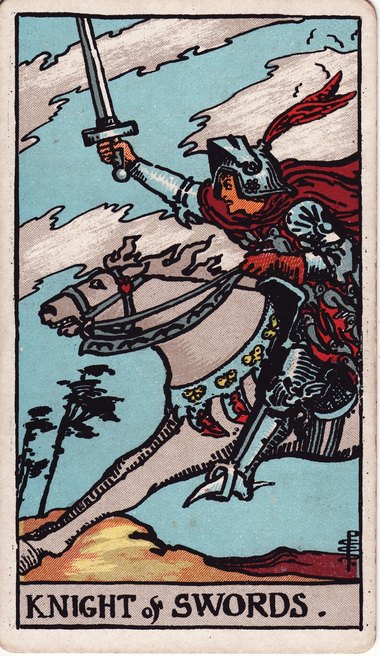
A horse at full gallop, all four feet off the ground. The rider has his sword up and forward, cloak straight out behind, and nothing in front of him to strike. The trees are bent flat and the clouds are streaks.
A charge: a decision acted on the moment it was made. The fastest card in the deck, and nothing at this speed can be steered. If you have already sent it, this is not the card for calling it back, and you knew that before you let go of it.
Four things people go to on this card
- the horse
You went to the horse. All four feet off the ground, head down, nostrils open, going flat out.
The animal is doing the deciding now. Past a certain speed the rider is a passenger with opinions, and the card draws the exact moment that changed hands.
Momentum is a real asset and it is not the same as control. Both are true in this picture at once, which is why this is the hardest court in the deck to advise. What you are on is fast and it is not yours, and the reins are decoration until it slows.
What is running now whether you agree with it or not, and where does it stop?
- the trees
The trees are what you saw, bent almost flat at the edge of the frame, and they are not moving because of him.
There was already a gale here, and it blows the way he is riding. He did not bring the conditions. They are at his back, adding to his speed, and a tailwind is the one wind nobody feels.
If you are about to move quickly, the card's one practical question is how much of the speed is yours. Some of it is weather. The trees know the answer before you have asked, and they are bent the same way you are going.
What are the actual conditions you are about to move fast in?
- the sword
You went to the sword. Up and forward, nothing in front of it, nobody to strike.
There is no opponent in this picture. He is charging at empty air with his weapon out, and the card gives the whole top of the frame to that emptiness.
Some urgency has no target. It is real force pointed at nothing specific, which is exhausting and looks from outside like purpose. You have the speed and the blade. What you do not have, yet, is a name.
What exactly is your sword pointed at, in one sentence, with a name in it?
- the clouds
You looked up. The clouds are not clouds any more; they are streaks, drawn the way speed is drawn.
The whole world has smeared. That is what it looks like from inside a charge: nothing legible, everything moving, detail gone.
You cannot read fine print at this speed and you should not try to. Either slow down for the detail or accept that you are choosing not to see it, but do not pretend you did both. Whatever you are about to agree to is a streak from where you are sitting.
What detail are you skipping because of the speed, and can it wait?
On the Tree of Life, Book T puts the Knight of Swords on Tiphareth, beauty, in Yetzirah, the world of air: the knights of all four suits sit there, one to a world. It is the sixth place in the Tree of Life spread.
Which zodiac signs does the Knight of Swords cover?
Twenty degrees of Capricorn to twenty degrees of Aquarius: the last third of Capricorn and the first two thirds of Aquarius, which the Sun crosses about 10 January to 9 February each year. Book T gives every knight thirty degrees across two signs like this, which is why a court card belongs to no single sign. The three decans inside it are Four of Pentacles · Five of Swords · Six of Swords, so a birth in any of them carries the Knight of Swords as well as its own card.
Draw a card, and if this one turns, press whichever of these four you went to and the reading is written from there instead. Pulled it in a spread of your own? Read the whole spread here.
← Page of Swords · Knight of Wands · Knight of Cups · Knight of Pentacles · Queen of Swords →