Page of Swords.
Braced, and facing the wrong horizon.
Upright, then reversed, as Waite gave them in 1910.
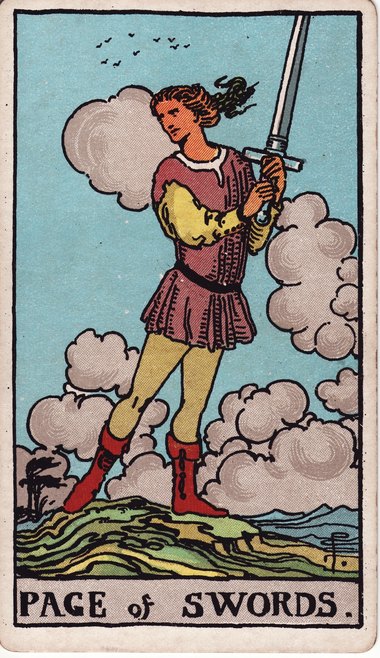
He stands on high ground with a sword held up in both hands, hair blown sideways, looking back over his shoulder. Clouds pile behind him, the trees at the edge lean, and a flock of birds rides the wind high above.
Someone new to the business of arguing, and on watch. The stance is correct. The direction is out of date, because he is watching the last thing rather than the next one, and you are braced the same way, at the same horizon, for something that has already happened.
Four things people go to on this card
- his shoulder
You went to the turn of his head. Body forward, face back, weapon up.
Readiness, pointed backwards. He is braced for the trouble he already knows about, which is the trouble least likely to arrive, since it has been and gone.
Everybody does this after a bad year. From inside it feels like prudence, and nobody tells you otherwise because from outside it looks like attention. Whatever comes next is in front of you, and it will find you looking the other way and calling that alertness.
What are you still braced for that already happened?
- the sword
You chose the grip. Both hands, high, blade upright, and he is not swinging it.
More sword than he can use one-handed, and he is holding it anyway. That is the Page exactly: the equipment of an argument he has not had yet.
Being armed and untested is not a failing. It is a stage. The card only asks that you notice you are in it, because pretending otherwise is how people pick the wrong first fight, and you have a first fight coming that you have been treating as a tenth.
What are you carrying that you have not actually used yet, and what would a small first test look like?
- the birds
You went to the birds. High up, small, riding the same wind that is knocking him about.
They are using the conditions he is bracing against. Same wind, an entirely different relationship to it, and they are above the weather rather than in it.
Air is the suit of thinking, and this is the card's note on it: the difference between being buffeted and being carried is almost entirely altitude. You are not in the wrong wind. You are at the wrong height in it, and height is a thing you can change.
What would this look like from higher up, and who do you know who is already up there?
- the wind
Everything is moving one way, and you saw it: his hair, the clouds, the trees, and none of it his doing.
The conditions here are not personal. Everything in the frame is being pushed, and he is simply the only thing in it standing upright and taking it as an insult.
Most of what is making this hard is weather. It will change. What you do while it blows is the only part that is about you, and at the moment that part is a grip and a scowl, which the wind does not notice.
How much of this is weather, and what would you do differently if you fully believed that?
On the Tree of Life, Book T puts the Page of Swords on Malkuth, the kingdom, in Yetzirah, the world of air: the pages of all four suits sit there, one to a world. It is the tenth place in the Tree of Life spread.
Which zodiac sign is the Page of Swords?
None, and that is the answer Book T gives. The Kings, Queens and Knights each hold thirty degrees of the zodiac, but the four Pages are given a quarter of the heavens around the pole instead, so the Page of Swords has no sign and no dates. What it does have is the whole of Swords under it: it is the earth of that suit, and on the Tree of Life it sits on Malkuth, the kingdom. A birthday cannot land on a Page.
Draw a card, and if this one turns, press whichever of these four you went to and the reading is written from there instead. Pulled it in a spread of your own? Read the whole spread here.
← Ten of Swords · Page of Wands · Page of Cups · Page of Pentacles · Knight of Swords →