Page of Wands.
First flare of interest, before it has a use.
Upright, then reversed, as Waite gave them in 1910.
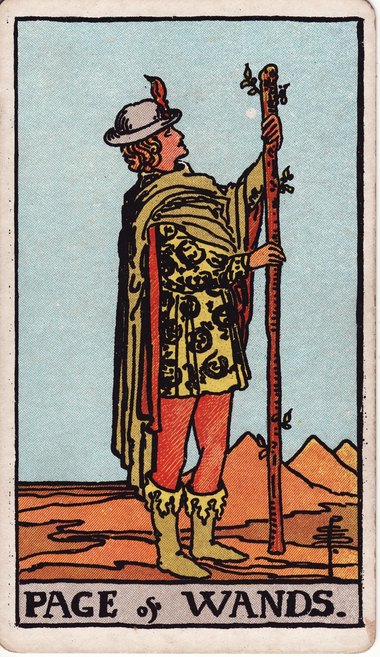
A young man on an open plain, holding a staff taller than he is and looking up at the top, where the leaves are. Salamanders on his tunic, tails open. A red feather in his cap, three pyramids a long way behind him.
No plan, only attention. He is looking at a stick because it has started growing, and Pages are the beginners of their suits, so this is the beginner at wanting. Something small has caught your interest, and the card does not want you to be sensible about it yet.
Four things people go to on this card
- his eyes
You went to where he is looking: up the staff, at the leaves coming out of the top of it.
He is attending to the thing itself rather than to what it is for. Not planning, not measuring, just examining a stick that has started growing, with both hands round it so it does not get away.
The moment of noticing that something is alive is earlier and better than the moment of having a use for it. Most people hurry through the first to get to the second. You are allowed to stay in it a while longer, and the card would prefer that you did.
What have you noticed lately that you have not yet tried to make useful?
- the salamanders
It was his tunic you touched, covered in salamanders, and their tails are open rather than closed.
In this deck a closed salamander, tail in mouth, is the finished thing; the King has those. The Page's are open, so the fire here has not yet come round to itself, and the emblem says so on his chest.
This is unfinished on purpose. Whatever you are looking at is not a lesser version of something. It is an early one, and the picture is telling you not to grade it yet, because grading is what closes the tail.
What are you judging as a poor version of something that is simply an early one?
- the pyramids
You went past him to the desert, three pyramids, small, on an empty plain.
Everything around him is finished, enormous and long dead, and he is holding a live twig. Standing in an old place at the beginning of something is the honest proportion of any beginning.
It does not mean stop. It means the thing in your hand is small and green and that is what it is supposed to be. The pyramids are not a standard; they are a horizon, and you are not required to build one before lunch.
Whose finished work are you standing next to, and is it stopping you starting?
- the feather
Your eye went to the feather in his cap, red, the same plume that streams off the Knight's helmet.
A family resemblance. The Knight wears the same red plume, larger and going faster, and the Page is the one who has it and has done nothing with it yet, which is not the same as having nothing.
If somebody in your life is at this stage, they are not being naive. They are being fourteen, in the sense the deck means it, and it is a real position with its own competence. Treat it as a fault and you will get the Knight sooner than you wanted.
Who in this is at the beginning of it, and are you treating that as a fault?
On the Tree of Life, Book T puts the Page of Wands on Malkuth, the kingdom, in Atziluth, the world of fire: the pages of all four suits sit there, one to a world. It is the tenth place in the Tree of Life spread.
Which zodiac sign is the Page of Wands?
None, and that is the answer Book T gives. The Kings, Queens and Knights each hold thirty degrees of the zodiac, but the four Pages are given a quarter of the heavens around the pole instead, so the Page of Wands has no sign and no dates. What it does have is the whole of Wands under it: it is the earth of that suit, and on the Tree of Life it sits on Malkuth, the kingdom. A birthday cannot land on a Page.
Draw a card, and if this one turns, press whichever of these four you went to and the reading is written from there instead. Pulled it in a spread of your own? Read the whole spread here.
← Ten of Wands · Page of Cups · Page of Swords · Page of Pentacles · Knight of Wands →