Ten of Wands.
Ten separate things carried as one.
Upright, then reversed, as Waite gave them in 1910.
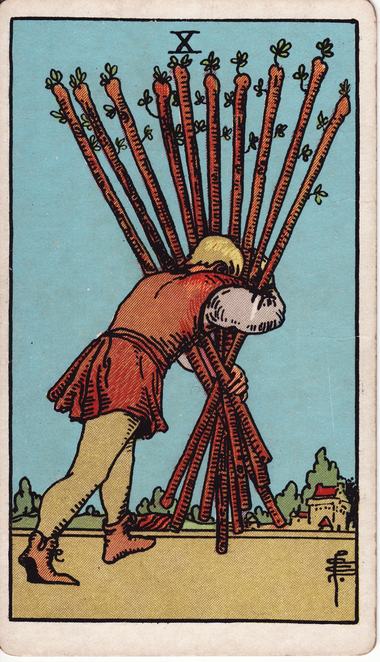
A man bent nearly double under ten staves, all held in one armful in front of him. His face is behind them. He is walking towards a town with red roofs that is close enough to see, and he cannot see it.
Ten separate things, carried as one. They are not one. Each staff went into his arms on its own day, for its own reason, and none of them is tied to the others. You have been calling ten things one thing so that you do not have to put any of them down.
Four things people go to on this card
- his face
You went to where his face should be, and it is behind the bundle; the card does not show it to you.
Whoever he was is not visible any more. That is the actual damage in this picture, not the weight. The load has become the front of him, and the town will see the staves arrive before it sees a man.
People who are carrying too much stop being asked how they are, because there is nothing showing to ask. If it has been a while since anyone asked you, the bundle is why, and it is not their fault they could not find your face.
When did somebody last ask you how you are, rather than what you are working on?
- the bundle
It was the ten you touched, all of them in one armful, and none of them tied to the others.
Look at how they are held. There is no rope, no strap, nothing binding them; the only thing keeping the ten together is his arms, and he has decided to carry them as one object.
That is the way out of this card, and it is unromantic. They can be put down one at a time, because they were never a single thing. Start with the one you picked up last; it has had the least time to feel necessary.
List the ten. Which one went in most recently, and does it have to be there?
- the town
You went to the buildings, red roofs on the right, close, and he is walking towards them.
The end is in sight and he cannot see it. It is genuinely near, a few hundred yards of flat ground, and he cannot look up because looking up means dropping something.
So the card is not despair. It is the last stretch, badly carried, and the town has people in it. Ask whether there is anyone there who would come out and take three of them, and whether you have let them know you are on the road.
Who could come out and take three of these off you, if you asked?
- his stoop
Your eye went to the bend in his back, folded almost double and still walking.
A posture held so long it looks normal. He is still moving, and that is what makes it dangerous rather than dramatic: nobody stops a man who is still making progress, least of all the man.
This is the suit of wanting. Something you actually wanted has been allowed to become the whole shape of you, and the stoop is what wanting looks like after it stopped being chosen and started being carried.
What did you want, that has quietly become the shape you now hold all day?
Its ten degrees
The Golden Dawn gave the Ten of Wands 20° to 30° of Sagittarius, ruled by Saturn, and Book T calls it the Lord of Oppression. The Sun is in it from 12 December to 21 December. The decan page for this card.
The wheel runs on from here. The decan before this one is Nine of Wands, the Moon in Sagittarius, 2 December to 12 December. The one after is Two of Pentacles, Jupiter in Capricorn, 21 December to 31 December. All thirty-six, in order.
On the Tree of Life, Book T puts the Ten of Wands on Malkuth, the kingdom, in Atziluth, the world of fire: every ten is Malkuth, in its own suit's world. It is the tenth place in the Tree of Life spread.
Draw a card, and if this one turns, press whichever of these four you went to and the reading is written from there instead. Pulled it in a spread of your own? Read the whole spread here.
← Nine of Wands · Ten of Cups · Ten of Swords · Ten of Pentacles · Page of Wands →