Queen of Swords.
Armed and open-handed in the same gesture.
Upright, then reversed, as Waite gave them in 1910.
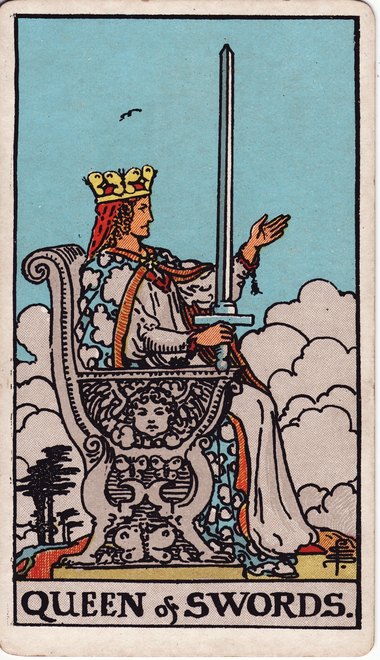
She sits in profile above a treeline, sword upright in one hand, the other raised and open. The throne is carved with a winged head and butterflies. One bird crosses the sky. Her face has been through something.
Clear judgement, and it was paid for. She is the only court in the deck both armed and gesturing at you, and she is not going to put either hand down to make herself easier to read. Somebody has asked you to, lately, and the card's answer is no.
Four things people go to on this card
- her open hand
You went to the empty hand. Open, raised, palm out, in a card where the other hand has a sword in it.
She is doing two things at once, and the card refuses to say which one is the greeting. It reads as a welcome and as a stop from exactly the same drawing.
People who have been through something often come out like this: available and edged, in one gesture, and misread constantly in both directions. You have been misread in both directions this year, and the card's point is that neither reading was wrong.
Which hand are people currently seeing when they look at you?
- the sword
The sword is what you chose. Perfectly vertical, held still, going nowhere.
A sword that is neither being swung nor put away. Held up, at rest, ready, which takes more strength than either alternative and shows less.
That is what a settled judgement looks like. Not the argument, not the surrender. The position held long enough that nobody bothers testing it any more, and you have one of those, and you have forgotten it costs you anything to hold.
What position have you held long enough that it no longer needs defending?
- the carved throne
You went to the throne. A winged head below the arm, butterflies worked into the stone.
The throne of the sharpest court in the deck is decorated with the two lightest things imaginable: an air spirit and butterflies. Somebody chose that.
The severity is the surface. What she is seated on is the creature that went into a case as one thing and came out as another, which is the least severe idea in the deck and the one that cost her the most. You did not arrive at this clarity by being clever. You arrived by being changed, and the butterflies are the only place the card admits it.
What did you have to become to be this clear, and does anyone know?
- the bird
One bird, high, alone, at the very top of the frame: that is where you went.
This card is set above the treeline. Not in company, not in the weather, just up, where the air is thin and there is exactly one other living thing.
Clarity is isolating and the picture says so without complaining about it. That is the trade. She can see a long way and there is nobody at this height. If you have been right about this for a while, look around and count who is still up here with you. The card counts one, and it has wings.
What has being right about this cost you in company?
On the Tree of Life, Book T puts the Queen of Swords on Binah, understanding, in Yetzirah, the world of air: the queens of all four suits sit there, one to a world. It is the third place in the Tree of Life spread.
Which zodiac signs does the Queen of Swords cover?
Twenty degrees of Virgo to twenty degrees of Libra: the last third of Virgo and the first two thirds of Libra, which the Sun crosses about 12 September to 13 October each year. Book T gives every queen thirty degrees across two signs like this, which is why a court card belongs to no single sign. The three decans inside it are Ten of Pentacles · Two of Swords · Three of Swords, so a birth in any of them carries the Queen of Swords as well as its own card.
Draw a card, and if this one turns, press whichever of these four you went to and the reading is written from there instead. Pulled it in a spread of your own? Read the whole spread here.
← Knight of Swords · Queen of Wands · Queen of Cups · Queen of Pentacles · King of Swords →