King of Swords.
A judgement that has already leaned.
Upright, then reversed, as Waite gave them in 1910.
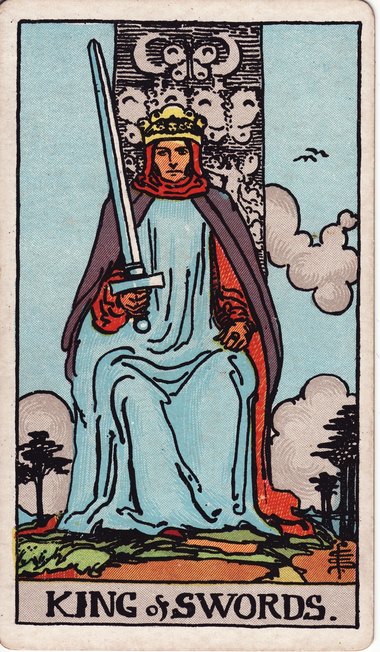
He sits facing straight out of the card, sword up in his right hand and tilted a little off the vertical. Butterflies and a crescent are carved into the throne. Two birds cross the sky behind him.
Authority through judgement: the judge, the analyst, the one whose word settles it. He is the only court in the deck who looks straight out of the card, and that puts you where the person making the case stands. You are not the judge here. You are the one explaining, and the sword has already leaned.
Four things people go to on this card
- the sword
You went to the angle. His sword is a little off upright, and the Queen's is exactly vertical.
A judgement that has already leaned. Not much. Enough that the card drew it, and enough that anybody arguing in front of him is arguing uphill without being told so.
Most decisions that present as open are at this angle. The useful question is never whether there is a lean; it is which way and how far. If you are the one arguing, find the tilt before you start.
Which way is your sword already tilted on this, and who has guessed?
- the butterflies
The carvings, then: butterflies at the top of the throne, worked into the stone above his head.
The same emblem is on the Queen's throne. It is the suit's own sign: air, and the creature that changes completely once and cannot go back.
A judgement built on that is not the fixed, cold thing people expect from this card. It is a position arrived at by having changed at least once, which is why it holds. You have one opinion that has never moved, and it is the one this card trusts least.
What did you change your mind about to arrive at the position you hold now?
- the birds
You went to the birds. Two of them, level with his head, on the right of the card.
The Queen's card has one bird and this one has two. The suit counts carefully, and it did not do that by accident.
Two is a conversation. Whatever authority this is, the picture puts something else in the air beside it, which is the difference between deciding and simply pronouncing. If you have been pronouncing lately, the second bird is the one you left out, and it is still in the frame.
Who is the second voice on this, and have you actually asked them?
- his face
His face is where you stopped. He is looking straight out of the card at whoever is holding it.
Every other court in the deck is turned away or looking at something. This one is looking at you, and he has been looking for a while.
That is the reading. You are the one being weighed here, not the one weighing, and the case you have been rehearsing is about to be heard by somebody who has heard it before. The card is asking whether your argument is ready or only long.
If you had to make the case out loud right now, in three sentences, what are they?
On the Tree of Life, Book T puts the King of Swords on Chokmah, wisdom, in Yetzirah, the world of air: the kings of all four suits sit there, one to a world. It is the second place in the Tree of Life spread.
Which zodiac signs does the King of Swords cover?
Twenty degrees of Taurus to twenty degrees of Gemini: the last third of Taurus and the first two thirds of Gemini, which the Sun crosses about 10 May to 11 June each year. Book T gives every king thirty degrees across two signs like this, which is why a court card belongs to no single sign. The three decans inside it are Seven of Pentacles · Eight of Swords · Nine of Swords, so a birth in any of them carries the King of Swords as well as its own card.
Draw a card, and if this one turns, press whichever of these four you went to and the reading is written from there instead. Pulled it in a spread of your own? Read the whole spread here.
← Queen of Swords · King of Wands · King of Cups · King of Pentacles · Ace of Pentacles →